
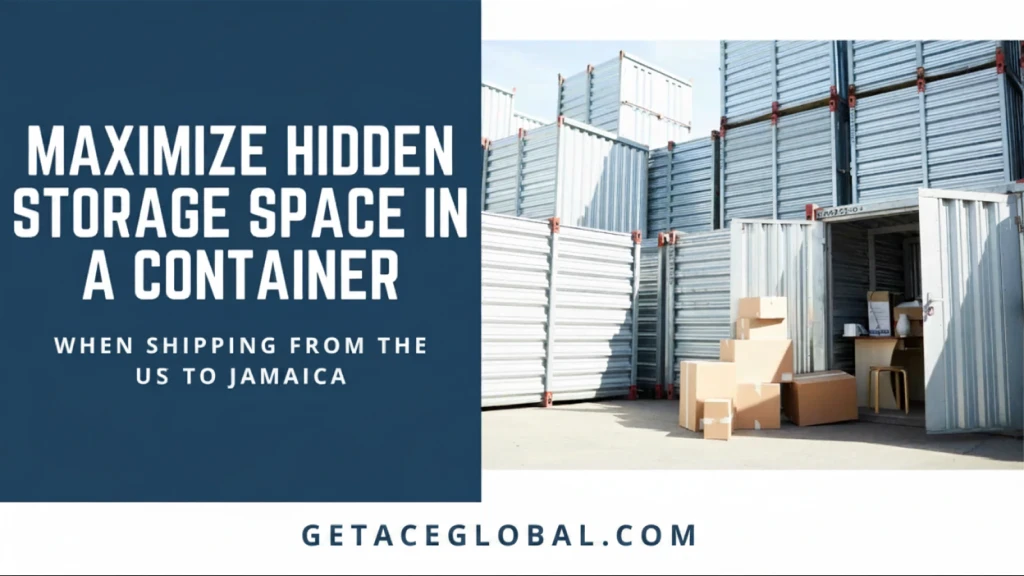
Shipping items to Jamaica can feel like a daunting task, especially when trying to save space in a container. There are so many different elements, including container sizes, types, uses, modes of shipping, and pallet selection what can determine the cost. Of course, you’ll want to maximize the space in your container and make sure you are getting the best return on investment. Effective planning and the right organization are key elements in a cost-effective shipping strategy. The question is: How do you cut shipping costs and maximize the space in your container? Have a look at our tips below, where we focus on 20-foot and 40-foot containers. The main concern of most people who get in touch with us comes down to weight. “Will I get charged extra if I add X item in my container?” or “My items weight X kilograms. Can I ship it?” The surprising truth is that weight doesn’t matter. Whether you’re using a 40-foot container OR A 20-foot one, the same pricing rate will apply. So what are you charged for then? Volume. To simplify it, Space. To save money and ship the most possible products, you need to focus on space utilization. In a few words, placing as many items to fill up the space of the container to its full potential. Weight shouldn’t be your concern and extra charges do not apply. Bear in mind that a 20-foot container can accommodate up to 25 cubic meters, while a 40-foot container can hold anywhere between 55 and 60 cubic meters. How we calculate and charge the volume The formula we’re using for calculating the volume is Height x Width x Depth = Volume. Shipping Cost = Volume x Shipping Rate (per cubic meter). To measure your items accurately use a tape measure. A very common question we get is “What if I mix up width or depth and I measure them wrong?”. Sometimes, it can get confusing. But here is the good news. It really doesn’t matter. Whether you confuse depth for width or width for height, the final calculation cost will be the same. [siteorigin_widget class=”SiteOrigin_Widget_Image_Widget”][/siteorigin_widget] [siteorigin_widget class=”SiteOrigin_Widget_Image_Widget”][/siteorigin_widget] [siteorigin_widget class=”PW_Call_To_Action”][/siteorigin_widget] What is Flat Pack Furniture and why should you prefer it over others? Flat packs are ready-to-assemble furniture or else self-assembly furniture which are produced in flat parts and can be assembled when purchased with minimal effort and without the need for special tools, at least in most cases. They’re packed in flat-packed boxes, at the time, separately, with all the necessary bolts and nuts for their assembly and with an instruction manual. Based on the type of furniture, the components to assemble could be anywhere from 5 to 50. IKEA is quite popular for its flat-pack retailed and flat-pack furniture delivery. When shipping your furniture overseas, and planning to purchase furniture, we highly recommend going with the flat-pack version of them. Despite being affordable, it will save you plenty of space in the container and allow you to ship more items, saving on your total costs. [siteorigin_widget class=”SiteOrigin_Widget_Image_Widget”][/siteorigin_widget] Utilizing hidden space gaps to save space in a container We’ve come across the same scenario numerous times. Customers shipping sofas, chairs, desks, tables, and other items that are not dismantled but yet again they have plenty of “empty space” in-between when wrapped and it is not utilized to its full potential. Then, they try to reposition items, stack them in a different way, trying to release space to fit everything. While those adjustments can work, we believe you can create the same effect with just a few small changes. Let’s have a look at the images below: [siteorigin_widget class=”SiteOrigin_Widget_Image_Widget”][/siteorigin_widget] [siteorigin_widget class=”SiteOrigin_Widget_Image_Widget”][/siteorigin_widget] [siteorigin_widget class=”SiteOrigin_Widget_Image_Widget”][/siteorigin_widget] [siteorigin_widget class=”SiteOrigin_Widget_Image_Widget”][/siteorigin_widget] [siteorigin_widget class=”SiteOrigin_Widget_Image_Widget”][/siteorigin_widget] [siteorigin_widget class=”SiteOrigin_Widget_Image_Widget”][/siteorigin_widget] [siteorigin_widget class=”PW_Call_To_Action”][/siteorigin_widget] After removing the pillows from this sofa, there is plenty of space on it to attach other small packages or items, before shipping it to Jamaica. How about putting some stuff in boxes and attach them on top of it? So many alternatives to experiment with. The same applies to furniture like desks, chairs, beds, and sofas. Ideally, there is to be no empty space left in the container by the time you’ve loaded all your stuff. Of course, it’s impossible to reach its full capacity but keeping those standards in mind will help you maximize the space you got. You don’t necessarily have to fill the empty space in your container exclusively with freight. You can add dunnage, matting, wood, or other material that can fill small spaces between cracks and crevices, minimize the shifting of contents, and absorb movement/shock. Securing items before shipping It’s very important to secure the items placed within, below, or above your furniture/other items in the best possible way. If an item cannot be secured with dunnage, you need to find alternative methods that prevent its movement like lashing with anchoring, blocking, or tie-downs. It’s very important to take every measure needed to prevent the contents from moving during shipping, as much as possible. The shifting or tiling of freight, along with any lateral or longitudinal movement can not only put your container items in danger but also the people who interact with your container. Preparing your items for the container Before Caribshipping arrives to load and transport your items onto the cargo, you need to make sure you package it properly. 1 – Use only new boxes for packing. Household items like books can work well with a cardboard book carton, whereas for kitchen appliances and bedding you’ll need line cartons. 2 – Use bubble wrap or even linens to cushion fragile items like photo frames etc. 3 – Make sure all items are well secured in their boxes and use strong adhesive tape to close them. Label each box with a number and its contents. Ex. Bathroom supplies, box 3 of 10. Keep a record of your items and box numbers. If anything gets lost or damaged, it will save you tons of time and money. 4 – Couches,

Here’s How Much Does It Costs to Clear a Container in Jamaica
Acquiring the necessary information for shipping is very important for preparation, do you
know how much it costs to clear a container in Jamaica?
A simplified Guide to Lorry types and Weight
If the driving axle, is not steering the axle has twin tyres and road-friendly suspension or each driving axle is fitted with twin tyres and the maximum weight for each axle does not exceed 8.55 tonnes. ** Distance between the rear axle of the motor vehicle and the front axle of the trailer is not less than 3 metres. *** If the vehicle is being used for combined transport (a) 5 axles or more artic and the 5 axles or more drawbar could alternatively have a 3 axle motor vehicle and a 2 axle trailer. (b) Conditions: – each vehicle must have at least 3 axles. – drive axle has twin tyre and road-friendly suspension and a maximum of 10.5 tonnes or each driving axle is fitted with twin tyres and has a maximum of 8.5 tonnes – trailer has a road-friendly suspension (c) Conditions for operation on 5 axles: – must have 3 axles on the tractor unit – single container 40ft in length conforming to standards laid down by the International Standards Organisation being carried only – vehicle being used for international journey. (d) Powered by a low pollution engine. [siteorigin_widget class=”SiteOrigin_Widget_Image_Widget”][/siteorigin_widget] OVERLOADING OF GOODS VEHICLES Why does overloading matter so much? ROAD SAFETY. Lorries which are loaded beyond their design weight are less able to stop quickly in an emergency and the steering of the vehicle can be affected. ROAD WEAR AND TEAR. It is estimated that the overloading of good vehicles costs the community over $50M a year through additional wear and tear to roads and bridges. Heavy axles cause proportionately far more wear and tear, and overloading drive axles (legal limit 11.5 tonnes) are the biggest single cause of excessive wear and tear on roads. COMPETITION. Gross overloading is unfair to the majority of law-abiding operators who accept the constraints of the plated weight limits set by the law. An operator who persistently overloads a lorry can earn additional profits amounting to thousands of pounds per annul SOME TECHNICAL TERMS EXPLAINED AXLE WEIGHT: GROSS VEHICLE WEIGHT: TRAIN WEIGHT: PLATED WEIGHT: TRAILER: DRAW-BAR TRAILER: SEMI-TRAILER: ARTICULATED VEHICLE: The total weight transmitted to the road by all the wheels on one axle. The weight of a vehicle and its load. The weight of a vehicle, a trailer and its load. Either the design weight limit is given on a manufacturer’s plate or the legal weight limit is given on the Department’s plate. Any vehicle is drawn by a motor vehicle. A trailer pulled by a rigid vehicle. A trailer forming part of an articulated vehicle. A tractor unit with a semi-trailer att OVERLOADING Goods vehicles are subject to U.K. weight limits. The weight limits are given on the manufacturer’s plate or the Department’s plate on each vehicle. They are determined by the technical specification of the vehicle and the need to protect U.K. roads and bridges from excessive wear and tear. Vehicles over 41 tonnes operate under special arrangements. 44 tonnes is allowed for combined (road to rail) transport. A vehicle is overloaded if it exceeds the plated weight limits. A vehicle could be overloaded on all its axles, on its gross weight and on its train weight. Each of these would be separate offences, e.g. a 3 axle articulated which exceeded the plated weights on the 1st axle, 2nd axle and gross weight would make both the vehicle operator and driver liable to three separate offences. A vehicle or vehicle combination from 1 January 1999 can operate under either The Authorised Weight Regulations 1998 or The Road Vehicles (Construction and Use) Regulations (as amended). This leaflet has been produced by the Department for Transport, at the request of the Magistrate’s Association to give guidance to Magistrates in dealing with cases on overloading. It is not intended to be a fully authoritative statement of the law

Guide on Shipping Containers From Jamaica to US
Understand the inner workings of shipping containers from Jamaica to the US from the capable experts at Ace Global US. Get more insights now. FIND OUT

Costs of shipping packages to Jamaica
2 things you need to know about cost to ship a package to Jamaica How much does it cost to ship a package to Jamaica? When you want to send a package overseas and don’t want to pay the high cost for airmail or don’t have enough goods to fill an entire crate or barrel on a boat, you may be able to save costs of shipping packages to Jamaica from the US. Of course, there is the initial cost of purchasing whatever it is that you are including in the package and then there is the actual cost to ship the package. In addition to these costs, the main fee will be when the package reaches customs in Jamaica. Provided you have not shipped any prohibited items, the contents should clear, and this cost will be charged to the recipient who picks up the package. Generally speaking, the two things you need to know about the cost to ship a package to Jamaica include the shipping price and any duties or taxes. Learn from the experts at Ace Global today about the different pricing & shipping structures. Choose an international shipping carrier International parcel shipping by boat While shipping by ocean vessel is usually the most cost effective way to send a parcel, if the package you are sending needs to arrive immediately, shipping it across the ocean may not be your best option. This choice can take anywhere from one to eight weeks. The two main Jamaican ports that allow the shipment of packages are Montego Bay and Kingston. When shipping, a letter or document mailer typically weighs between 230g to 2kg and a parcel is a package that weighs 500g and above. Take your package to a postal shipping company who handles sending packages internationally across the sea. The clerk will weigh and measure your package. The costs involved at this step will include the shipping fee and any insurance you choose to purchase. Once it arrives in Jamaica, the recipient will be required to pay a duty to clear customs. When shipping to Jamaica, there is typically a standard box rate that covers the warehouse receiving, tallying, and loading the cargo as well as documentation costs and ocean transportation charges. They are often sent as LCL Less than Container Load where a crate shares the space with multiple senders in order to fill the space. The rates are going to vary depending on the cubic space that your cargo occupies inside the shipping container along with local destination charges. Customs clearance and duties or taxes are the obligation of the receiving party. [siteorigin_widget class=”PW_Icon_Box”][/siteorigin_widget] Label and package properly Pack your items securely and label correctly Packing your items correctly can help you reduce costs of shipping to Jamaica a lot. When sending items as a parcel that are packaged and weigh more than 500g, you will need to show a valid government issued ID card, voters’ ID, or drivers’ licence or passport, TRN, full name, address, telephone number and/or email address of both the sender and the addressee. Don’t seal your package or envelope as it will need to be checked at the counter. Fill out the shipping label to address it to the person or business in Jamaica. The label should list the person or business on the first line. The second line should include the full street address. The third line needs to list the city and province followed by the Parish. The last line should read, “Jamaica” or sometimes “Jamaica, W.I.”. There are no zip codes in Jamaica. Fill out customs form Provide proper paperwork When you are sending a package to Jamaica, you will also need to complete a customs form to make it easier to clear customs once it arrives. Be sure to fill it out completely and itemize every item inside the package. When your recipient picks up the package, they will need to bring a valid government issued ID, passport, national voters ID or drivers’ license. If someone is sent on someone’s else behalf to pick up the package, they will need an authorization letter from you, signed by you and stamped by a Justice of the Peace, a copy of your and their valid government issued ID. If the parcel is registered, they will need to present the registered slip at the post office when collecting the item. Cover your valuables with protection from damage It’s a good idea to also purchase insurance to make sure the contents of your parcels are covered from damage during transit. This insurance rate is based upon how much the items inside the package are claimed to be worth. At the very end, this one of the most important costs of shipping to Jamaica. Don’t send prohibited items Send only items that are allowed There are a few items that are prohibited from being shipped to Jamaica, so be sure that anything you send is allowed and not on the prohibited list. Some of these restricted items include dangerous articles, indecent items, illegal substances, medicine, live animals, and any item that may be harmful or offensive, including: explosives flammable items compressed gases corrosive liquids oxidizing substances poison radioactive materials pharmaceuticals fresh meat soiled clothing plants or fruit hides, skin, wool tobacco playing cards salt lottery tickets alcohol any indecent or obscene print any threatening print articles infringing trademark or copyright laws writing or print impressed across the postage stamps before posting Contact us for more useful information related to shipping packages from US to Jamaica using one of our social links below.
Shipping Motor Vehicles to Kingston, Jamaica
4 things you need to know about shipping motor vehicles to Kingston Jamaica So, you have a car that you want to send ahead so it’s ready to drive when you arrive at Jamaica. Or, you are a resident who has recently returned to Jamaica and need your motor vehicle to follow. Regardless of your reason why, the fact is that you need to know how to ship a motor vehicle to Kingston, Jamaica. Before you take another step, follow these four things you need to know about shipping motor vehicles to Kingston, Jamaica. How will my car be shipped? RORO, Roll On/Roll Off Method of shipping A very common method used to ship a vehicle is the RORO Roll On/Roll Off method. This is the most cost-effective method of shipping to Kingston. The way it works is that the car is driven on the board of a ship and secured. Then, it is driven off of the ship. In order to ship this way, you will need to remove all accessories and personal items from the car prior to shipping. Due to the way that customs work in Jamaica, it is advisable to ship your car empty and free of contents. Try not to be tempted to fill the space in the boot or inside the vehicle with household goods. These are valued by a separate department of customs. Normally a detention notice will be placed on the goods inside the vehicle and these removed for separate valuation. This can lead to loss of your goods as they will not be kept in a sealed storage unit. Usually they are palletised and removed to a separate berth on the wharf for valuation of duties. Though a bit more costly, the container method is considered the safest way to ship motor vehicles. It is especially useful if you want to use a container to ship your vehicle and perhaps have other household goods or items you want to send along with your vehicle. Your car and other cargo is sealed inside a 20 or 40-foot container. The car is secured to avoid movement during shipment. Prepare the proper documents and get approval to ship motor vehicles The first step is to apply for approval Before you will be able to ship your motor vehicle or motorcycle to Kingston, Jamaica you will need to apply to the Jamaica Trade Board for an Import Licence and receive approval. Do this through the Jamaica Customs Agency. It is also a good idea to check with the Embassy of Jamaica to obtain all of the most up-to-date information about import laws for motor vehicles to Montego Bay. If you require further assistance you can contact the Jamaica High Commission in the US prior to export of your vehicle. Prepare the necessary documents To get approval for shipping a motor vehicle, you will need to gather together the necessary documents. The documents required will not only show proof that you own the vehicle but that it is acceptable to come into Jamaica and will be used to assess taxes through customs. Prepare the following documents to have on hand: Import licence The vehicle registration document Bill of Lading/Order from us Valuation for vehicle. This could be in the form of a receipt for a recently purchased vehicle, or an insurance valuation. Bill of Sight Tax Compliance TCC Simplified Administrative Document (eSad) obtained from customs JA Motorcycles, Pick-up and Truck Cabs, as well as Pick-up Beds will also require a permit from the Trade Board, Ltd. The import licence will be issued by the Trade Board Limited. It will authorize you to import your motor vehicle. To gain approval, you will need to show proof of ownership by presenting the vehicle registration document. This title must be issued by the government of the country where the vehicle was purchased and the VSC or vehicle title will be required at the port of entry. The Sea Waybill or original Bill of Lading/Order must be obtained from the local clearing shipping agent with detailed information about the vehicle as well as the date it landed on the island and the port of entry. The invoice needs to come from the supplier and is required for all vehicles being shipped. The Bill of Sight is a document with details about the motor vehicle that is being imported and is prepared and signed by the broker and then certified by Customs. The Tax Compliance TCC will be obtained from Tax-Adminsitration Jamiaca. This has to be from a main Tax office in a Parish of Jamaica. Finally, the Simplified Administrative Document (eSad) is an electronic document that can only be completed by a licensed Customs Broker. It lists all of the particulars of the vehicle, the importer’s name, shipping information and the Customs duties are recorded. It is completed by the Customs Broker and submitted to Customs. You will need to locate a suitable customs broker in Jamaica when you attend. There are plenty of agents to chose from and these persons are frequently located at the wharf, or you can locate a list of verified brokers from US Jamaica high commission. Cost value of your motor vehicle musts be assessed Determining value Custom’s levies in Jamaica are high, so expect to pay as much as 60 percent or more of the cost of the car as custom duty. You can view list of calculated duties on this link To clear customs in Kingston, import Duty, special consumption tax and a GCT is compounded. A processing fee and environmental levy is tallied and included in the aggregate Duty. Customs will assign the value to the motor vehicle in order to determine the duty. [siteorigin_widget class=”PW_Call_To_Action”][/siteorigin_widget] The WTO Agreement states that invoices should be presented to Customs so the proper value of your motor vehicle can be derived. There are special circumstances that may allow concessionary rates of duty on vehicles, such as when the importer holds a job or position